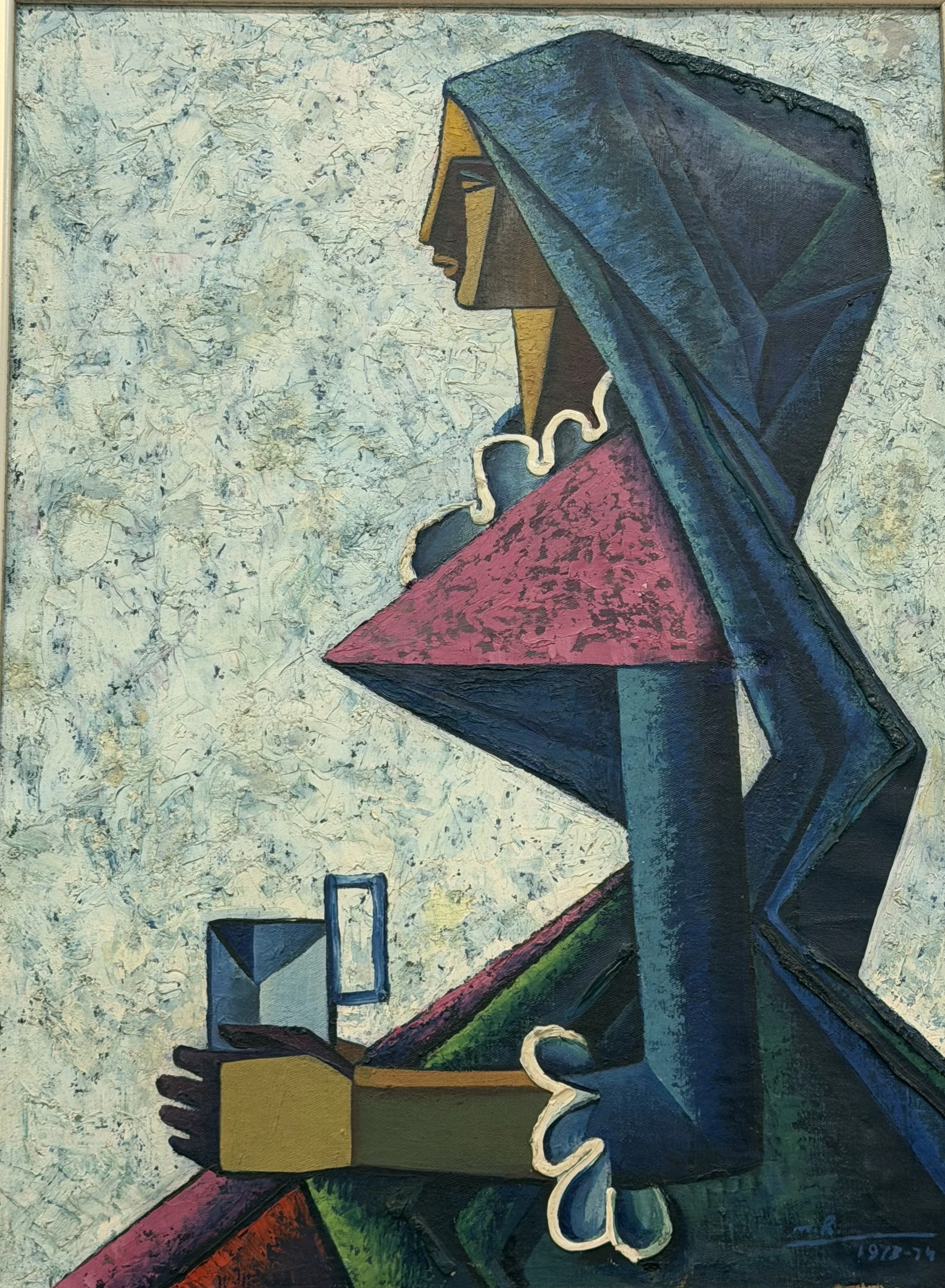
Otar Chkhartishvili’s Woman in a Blue Cloak (1973–74) at the Georgian Museum of Fine Arts in Tbilisi.
The woman is almost architected from luminous blue. Her cloak gathers around her in angular planes, interrupted by a jewel-like pink, while the pale surface surrounding her seems alive with texture. I stopped.
I encountered Otar Chkhartishvili’s Woman in a Blue Cloak (1973–74) at the Georgian Museum of Fine Arts in Tbilisi. By then, another detail had begun following me through the museum. Again and again, in the histories surrounding Georgian artists, I encountered references to the censorship of formalism—the suppression of artistic approaches that did not conform to the aesthetic expectations of Soviet cultural authority.
I had come to passively look at art. Instead, I found myself asking: What happens to beauty when someone else has the authority to determine the forms through which beauty may appear?
I do not know that Chkhartishvili intended Woman in a Blue Cloak to answer this question. I am increasingly wary of asking an artwork to become evidence for whatever argument I happen to be developing. The painting did something more interesting. It held the question open.
When the painting leaves the museum
Later, over dinner in Tbilisi, the museum followed me to the table.
In front of me was a Georgian cheese plate, surrounded by little tastes of natural amber wine—moving from the crisp brightness of Imereti to the funkier, earthier expressions of Kakheti. Somewhere between bites of cheese and another curious sip of amber wine, the paintings I'd left behind at the museum began finding their way into conversation.
We returned to formalism, censorship, and the boundaries placed around artistic expression. Then, amid all that deliciousness, someone placed a deceptively enormous question on the table: What is freedom?
The woman in the blue cloak did not tell me. She had simply made a question available to me that I had not previously known how to hold. Days later, the question returned through an entirely different cultural world.
Cultural researcher and art historian, Marianna Fioretti, was reflecting on the paradoxes surrounding contemporary diversity: how forms of dress associated with covered women can become aesthetically desirable within fashion while women wearing related forms of dress may simultaneously be treated as socially suspect, politically deficient, or insufficiently integrated.
Something clicked. Representation is not recognition. Something can become aesthetically visible without becoming politically free. A cultural expression can be admired while the people associated with it remain institutionally illegible. Beauty can be welcomed into the image without legitimacy following the person into everyday life.
And the economist in me began asking a slightly different question: Who has the power to make their interpretation of freedom consequential?
Perhaps this is something taste accumulates
We often describe taste through preference. What do you like? What do you collect? Which artists can you identify? Which maisons, movements, vintages, or periods have you learned to distinguish? But perhaps sustained cultural encounter develops something else: recognition as a capacity.
A sophisticated collector may own 47 paintings. But she may also have spent thirty years training her perception. Thirty years of looking. Reading. Traveling. Returning. Discussing. Acquiring. Being surprised. Occasionally discovering that something she once believed was wrong. The paintings are not merely objects in her possession. Over time, they become encounters that alter what she can recognize—in an image, in an institution, in a market and perhaps in herself.
Imagine that decades spent with twentieth-century art have made our collector unusually sensitive to the relationship between formal freedom and political freedom. She has learned to notice how artists develop abstraction, ambiguity, experimentation or beauty under conditions that may constrain what can safely be said, exhibited, supported or recognized as legitimate. Perhaps she never consciously decided to acquire this capacity. And then one afternoon in Tbilisi, a woman wrapped in blue gives thirty years of looking somewhere new to land. Suddenly, the question is no longer only what our collector owns. It is: What have thirty years of ownership prepared her to steward?
The architecture knows what to do with the paintings
This is where the economic problem becomes interesting. Suppose some of those 47 paintings sit within a private trust established as part of her family's wealth and estate planning. The trust may be extraordinarily sophisticated. It can establish who legally owns the works, who benefits from them, who exercises control, what happens when she dies, and under what circumstances trustees may retain, sell, or distribute them. Around that structure, advisers can address valuation, insurance, taxation, conservation and succession.
In other words: The financial architecture can be remarkably good at stewarding the assets she owns.
But it does not inherently know what to do with the recognition capacity those assets helped produce in her. Suppose her encounter in Georgia develops into a sustained relationship with Georgian modernism. She wants scholarship to exist. Important texts translated. Artists and thinkers gathered into rooms where difficult questions can remain difficult.
Perhaps she wants to acquire work strategically, commission new work, finance research, support an experimental exhibition before a major institution is willing to take the risk, introduce Georgian artists to collectors, or simply spend another year learning before deploying capital at all.
So perhaps she turns to philanthropy.
A donor-advised fund can provide sophisticated machinery for charitable giving. It can allow her to recommend grants to eligible charitable organizations within the vehicle's governing rules. Useful. But what she has recognized may not organize itself neatly around charitable distribution. Some needs may be philanthropic. Others may require acquisition, commerce, commission, hospitality, scholarship, relationships, patient ownership, or simply sustained attention.
One cultural intention may require several forms of capital moving differently around the same cultural world. Neither the trust nor the donor-advised fund has failed. Each may perform beautifully at the function it was designed to perform. The mismatch is elsewhere. The capital has been given machinery designed for a different purpose.
Recognition precedes allocation
This is one reason patronage deserves considerably more economic sophistication than we currently give it. Before capital can be intelligently allocated toward culture, someone must become capable of recognizing what matters. And money may be only one resource she eventually mobilizes. There is also ownership. Attention. Knowledge. Relationships. Access. Hospitality. Governance.
The economic question is therefore not merely how much cultural capital someone owns. It is what a lifetime of cultural encounter has made her capable of seeing—and whether an architecture exists through which that recognition can become consequential. This is where patronage separates itself from two disciplines with which it is often conflated.
Investing asks how capital can produce financial return.
Philanthropy asks how capital can advance charitable purpose or public benefit.
Patronage asks what a person has learned to recognize as culturally significant—and what combination of capital, ownership, attention, relationships, and care might allow it to flourish.
These disciplines can overlap. They are not interchangeable. Patronage is not philanthropy with more beautiful beneficiaries. Nor is it investing with prettier assets. It begins from a different question.
Perhaps this is why I am still thinking about the woman in the blue cloak. I had walked into the museum looking for wonder: willing to disappear for an afternoon into beautiful things. And there she was—a woman enveloped in haunting blue, an insistent pink breaking through her cloak like a question I had not yet learned how to ask.
I left her hanging on a museum wall in Tbilisi. But she entered dinner. Then fashion. Then politics. Then economics. Somewhere between the haunting blue and insistent pink, wonder had acquired consequence. She did not tell me what freedom means. She changed what I was capable of noticing about it. Perhaps that is one of beauty’s most consequential forms of capital.
What has beauty taught you to recognize? 🌷
Continue the Inquiry
The Permanence Diagnostic™ is a private assessment for individuals who have encountered a cultural world, collection, tradition, place, practice, or body of work they do not quite want their relationship with to end.
Beginning with the question: What must remain possible for the thing I love to continue existing? The diagnostic helps clarify what has captured your attention, why it matters to you, and what a thoughtful long-term stewardship relationship might look like. It is not designed to tell you what to value or where to give. It is a space to recognize what you already care about and begin translating that recognition into stewardship.
About the Author
Danetha Doe is a cultural economist and founder of Power Glam Economic Atelier, where she is developing the Economics of Cultural Stewardship as a field of inquiry and practical discipline.
Her work explores how cultural significance is recognized, how relationships of stewardship form, and how capital, governance, and institutional architecture can help cultural worlds endure across generations. She is the creator of the Permanence Diagnostic™, a private assessment for individuals beginning to shape their own stewardship practice.