Why Cultural Economies Are Incomplete Without the People Who Recognize, Commission, Collect, Host, and Sustain Culture
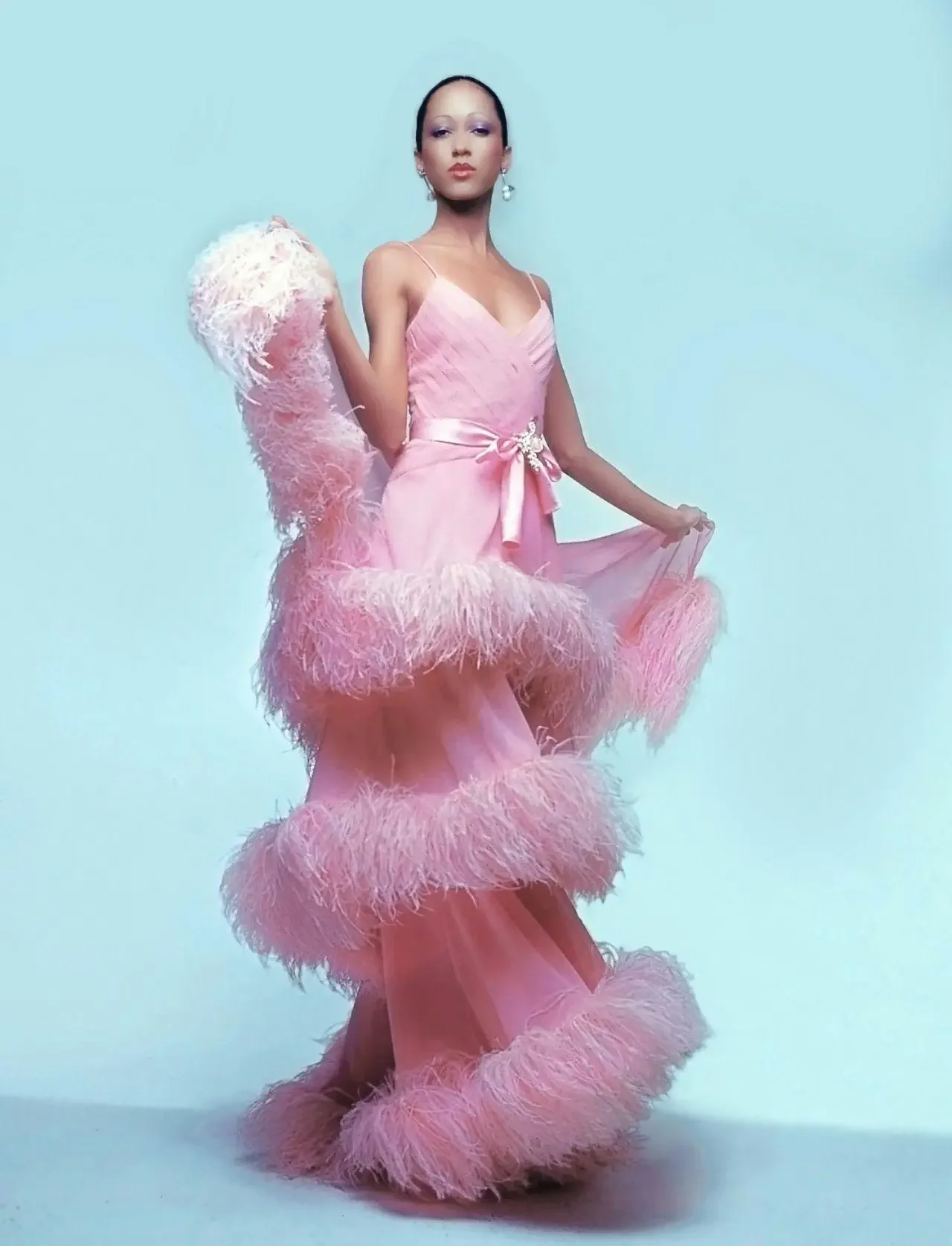
Pat Cleveland stands inside a cascade of pink silk chiffon and ostrich feathers.
The evening ensemble was designed by Valentino Garavani for 1974–75, but the cultural system visible in this photograph extends far beyond Valentino. Cleveland is wearing the garment for the Ebony Fashion Fair, the traveling fashion institution created by Eunice Johnson that brought couture before Black audiences across the United States. (VPM: Virginia's Home for Public Media)
It would be easy to tell this story as one of access: European couture finally entering a Black cultural world from which Black models and consumers had historically been excluded. But that interpretation misses something economically important. Black glamour was already there.
So were Black wealth, taste, social life, aspiration, beauty, and cultural authority. Johnson was not waiting for a European fashion house to create those things. She possessed something the houses themselves needed: a discerning buyer, a sophisticated audience, a distribution platform, and an institution capable of turning a garment into cultural experience. Johnson built an infrastructure through which Black audiences could exercise their own relationship to international couture.
Pat Cleveland later recalled that Johnson traveled to European shows, bought collections, and presented them in American cities before elite Black audiences. Cleveland went so far as to credit Johnson with putting Yves Saint Laurent “on the map,” while naming Cardin, Dior, Givenchy, and Chanel among the houses she brought into that world. Johnson Publishing's history similarly records that she bought from young designers others were hesitant to back, including Valentino, Cardin and Saint Laurent, before they became established names. (The Guardian)
Look at the photograph again. Valentino made the garment. Cleveland animated it. But Johnson recognized it, acquired it, placed it, and built the cultural infrastructure through which an audience could encounter it.
Cultural economies have language for the designer. We have language for the model. We have language for the fashion house and, eventually, for the museum or archive that preserves the object. We are considerably less precise about the economic function performed by the person in between. That is the missing Cultural Host.
THE MISSING ACTOR
We possess sophisticated ways of understanding many participants in cultural economies. Artists create. Craftspeople make. Galleries sell. Markets price. Museums collect. Archives preserve. Universities study. Governments and foundations fund. Yet cultural significance rarely travels neatly from creation to market to institution.
Someone recognizes significance before consensus. Someone commissions an experiment. Someone buys the work before a stable market has formed. Someone introduces the maker to another circle. Someone creates the room in which relationships develop. Someone builds the collection. Someone preserves the object long enough for history to reconsider it.
These activities may appear social, aesthetic, or personal. But they can produce economic consequences. Power Glam uses Cultural Host to describe this function: the person who mobilizes financial, social, cultural, and relational capital around a cultural world, helping create the conditions through which significance can be recognized, experienced, supported, and carried forward.
The Cultural Host does not necessarily make the culture. She helps make its cultural life possible.
THE CULTURAL HOST IS MORE THAN MONEY
Modern conversations about patronage frequently become conversations about funding. Who donated? How much? To which institution? Those questions matter. But they capture only one form of capital.
The Cultural Host may recognize, commission, collect, convene, introduce, finance, preserve, interpret, or transmit. She may create demand before a stable market exists. She may place a maker before an audience capable of understanding the work. She may use social relationships to move something from obscurity toward recognition. She may preserve what institutions have not yet learned to value.
Johnson's work makes this particularly visible. She did not simply purchase couture. She exercised judgment about what would enter the cultural world she was building. Designers themselves noticed that judgment: Pierre Cardin later praised her ability to identify the most important looks in a collection, while Bill Blass remembered that she bought—not borrowed—some of the most daring work. (System Magazine)
The Cultural Host, then, does not merely finance cultural significance after it has been established. At times, the Cultural Host helps establish where significance will travel next.
RECOGNITION IS ALSO POWER
This role should not be romanticized. To recognize is also to select. To commission is to influence what gets made. To collect is to influence what survives. To host is to shape who enters the room. To confer legitimacy is to participate in determining whose work receives cultural authority. The history of cultural patronage therefore contains generosity and exclusion, discernment and hierarchy, preservation and erasure.
That is precisely why the Cultural Host deserves economic study. The question is not whether wealth or cultural authority is inherently benevolent. The question is: What does this power make possible—and what does it prevent from becoming possible?
Johnson's authority offers one answer. Her selection did not flow in only one direction, from Europe toward Black America. She also promoted Black designers including Stephen Burrows, Patrick Kelly, Willi Smith and others, while creating opportunities for Black models whose careers would extend far beyond the Ebony Fashion Fair. (Getty)
Her judgment shaped what audiences encountered. That is not merely taste. It is an allocation function.
THE PATRONAGE LAYER
This suggests that cultural economies contain a layer that is easy to overlook precisely because it is dispersed across people, relationships, collections, dining tables, memberships, purchases, introductions, commissions, homes, social circles, and institutions.
I call this the patronage layer. Its participants need not share the same title or financial structure. What connects them is function: their judgment, relationships, resources, and participation influence whether cultural significance develops continuity.
The patronage layer therefore forms part of what Power Glam calls Recognition Infrastructure™: the systems through which societies learn what to notice, what to value, whose authority to recognize, and what may deserve continuity. Seen this way, patronage is not simply wealthy person… donates money… impacts culture.
It can be: recognition…relationship…participation…capital…continuity. The Cultural Host becomes one mechanism through which private recognition acquires cultural consequence.
THE CULTURAL HOST MAY BEGIN WITH PLEASURE
And yet very few people wake up one morning hoping to become cultural infrastructure. They love something first. Architecture. Gardens. Jazz. Jewelry. Fashion. Literature. Cars. Food. Hospitality. Craftsmanship. Pleasure creates attention. Attention can become knowledge. Technique becomes visible. Then provenance. Lineage. Authorship. Material. History. Taste becomes a form of literacy.
Eventually, a different question becomes possible: What must remain possible for the thing I love to continue existing?
This is a subtle but important shift. The person admiring the Valentino dress need not begin with an abstract obligation to preserve couture. She might first become curious about what makes its movement extraordinary. That curiosity can lead toward craftsmanship, atelier knowledge, materials, designers, models, archives, collectors, and the economic conditions supporting them. The object reveals the system upon which its beauty depends. And at some point, appreciation may become participation. Not through guilt. Through deeper attachment.
CULTURE NEEDS MORE THAN PRODUCERS
This matters because cultural abundance can coexist with weak stewardship capacity. A society can have extraordinary artists while letting the conditions that support artistic experimentation disappear. It can celebrate craftsmanship while losing craftspeople. It can fill museums while weakening the systems through which future significance emerges. It can preserve objects while failing to regenerate the cultural worlds that gave those objects meaning.
The finished cultural object therefore tells us only part of the economic story. Luxury frequently presents the object as evidence of excellence. Cultural stewardship asks whether the systems capable of producing that excellence remain viable.
This is where the Cultural Host re-enters the picture. Creators matter. Markets matter. Institutions matter. But so do the people capable of recognizing significance, gathering others around it, directing resources toward it, and creating social conditions in which caring for its future becomes desirable.
RECOVERING THE MISSING CULTURAL HOST
Return once more to Pat Cleveland in pink. Today, the photograph can be read as fashion history. Valentino's authorship can be catalogued. Cleveland's importance can be remembered. The garment can become heritage. But none of that explains how this particular object entered this particular cultural world. For that, we need Eunice Johnson. We need the person who looked. Who selected. Who bought. Who placed. Who gathered. Who understood her audience. Who possessed enough authority to decide that this object belonged inside the world she was building.
Johnson did not need European couture to create Black glamour. She used her own capital, judgment, institution, and cultural authority to determine how international couture would participate in an already existing Black world. That economic function deserves a name and considerably more study. The Cultural Host is not missing from cultural history. The Cultural Host may be missing from our model of how cultural economies work.
And perhaps recovering her changes something about our own relationship to beautiful things. We can begin with more intimate questions. What do I love? What had to remain alive for me to encounter it? And what might my relationship to that world make possible for someone who comes after me?
Taste need not end with acquisition. It can become a way of assuming responsibility for the conditions of beauty.
Continue the Inquiry
The Permanence Diagnostic™ is a private assessment for individuals who have encountered a cultural world, collection, tradition, place, practice, or body of work they do not quite want their relationship with to end.
Beginning with the question: What must remain possible for the thing I love to continue existing? The diagnostic helps clarify what has captured your attention, why it matters to you, and what a thoughtful long-term stewardship relationship might look like. It is not designed to tell you what to value or where to give. It is a space to recognize what you already care about and begin translating that recognition into stewardship.
About the Author
Danetha Doe is a cultural economist and founder of Power Glam Economic Atelier, where she is developing the Economics of Cultural Stewardship as a field of inquiry and practical discipline.
Her work explores how cultural significance is recognized, how relationships of stewardship form, and how capital, governance, and institutional architecture can help cultural worlds endure across generations. She is the creator of the Permanence Diagnostic™, a private assessment for individuals beginning to shape their own stewardship practice.