Why Culture Requires Permanence Capital™—Not Just Cultural Funding
A Power Glam essay examining why patronage may have more in common with sovereign wealth funds than philanthropy—and what this means for the future of cultural stewardship.
The recent European declaration Europe for Culture – Culture for Europe offers a revealing observation about the future of culture.
Throughout the declaration, culture is described as a public good, a strategic resource, a source of competitiveness, a source of resilience, a foundation of democracy, and a cornerstone of European identity. This is significant. For decades, cultural advocates have argued that culture should be understood as more than entertainment, tourism, or discretionary spending. The declaration appears to acknowledge precisely that. Culture is positioned as a strategic capability. A civilizational asset. A force shaping identity, cohesion, resilience, and future prosperity.
Yet a curious shift occurs when the conversation reaches funding. The declaration commits to supporting sustainability through different forms of funding and considering innovative and alternative funding mechanisms. An important commitment. Yet also a revealing one. Because the question of how culture should actually be capitalized remains largely unresolved. The declaration successfully establishes culture's importance. The capital architecture remains open.
And perhaps that is because modern societies still lack a coherent framework for stewarding significance across generations.
The Funding Question Nobody Has Solved
Most modern societies already agree that culture matters, artists matter, heritage matters, creativity matters, cultural institutions matter.
Acknowledgment is no longer the primary challenge. Yet museums remain constrained. Contemporary artists’ future capabilities remain precarious. Emerging maisons struggle to access patient capital. Archives remain vulnerable. Cultural institutions frequently operate under recurring financial pressure. Why?
Because acknowledgment is not capital architecture. The challenge is not legitimacy. The challenge is continuity. Modern societies have become increasingly sophisticated at acknowledging cultural value. They remain comparatively unsophisticated at financing cultural continuity.
Philanthropy, Investing, and the Missing Category
Part of the confusion may emerge from attempting to place culture inside capital systems designed for different purposes.
Philanthropy asks: What problem should be solved?
Investing asks: What return should be generated?
Patronage asks: What significance should survive?
These are not variations of the same question. They are different mandates. The problem is not that philanthropy fails. The problem is not that investing fails. The problem is assuming either was designed to perform the function of patronage. Patronage occupies a distinct category. One concerned less with problem-solving or return generation and more with continuity. Its purpose is not merely to improve conditions. Its purpose is to ensure that significance survives long enough to become permanent.
Why Sovereign Wealth Funds Are an Unexpected Analogy
At first glance, sovereign wealth funds appear unrelated to patronage.
Yet they may provide one of the clearest analogies available. Consider Norway. Norway does not simply preserve oil. Norway converts a finite resource into future capability. The resource becomes a mechanism for protecting continuity. The civilization becomes the asset. The fund exists not merely to maximize quarterly returns, but to preserve national capacity across generations.
This distinction matters. Because culture may operate similarly. The painting may not be the asset. The capability producing wonder may be the asset. The luxury house may not be the asset. The aesthetic intelligence may be the asset. The institution may not be the asset. The cultural capability sustained by the institution may be the asset.
Viewed this way, patronage begins to resemble a sovereign function. Not because it belongs exclusively to governments. But because it concerns the preservation of capabilities that outlive individual market cycles.
Introducing Permanence Capital™
Most capital systems begin with a familiar question: What must grow?
Permanence Capital™ begins somewhere else. What must survive?
Permanence Capital™ refers to capital allocated toward preserving and regenerating capabilities whose significance exceeds their immediate economic output. The objective is not short-term liquidity. The objective is long-term continuity.
Examples might include ateliers, craft lineages, archives, cultural institutions, artist ecosystems, emerging maisons, educational transmission systems, symbolic literacy systems. These assets often generate economic activity. But their deepest value may lie elsewhere. They preserve capabilities that future generations cannot easily recreate once lost.
A Different Capital Logic
Seen through this lens, Permanence Capital™ occupies a distinct position among existing capital frameworks.
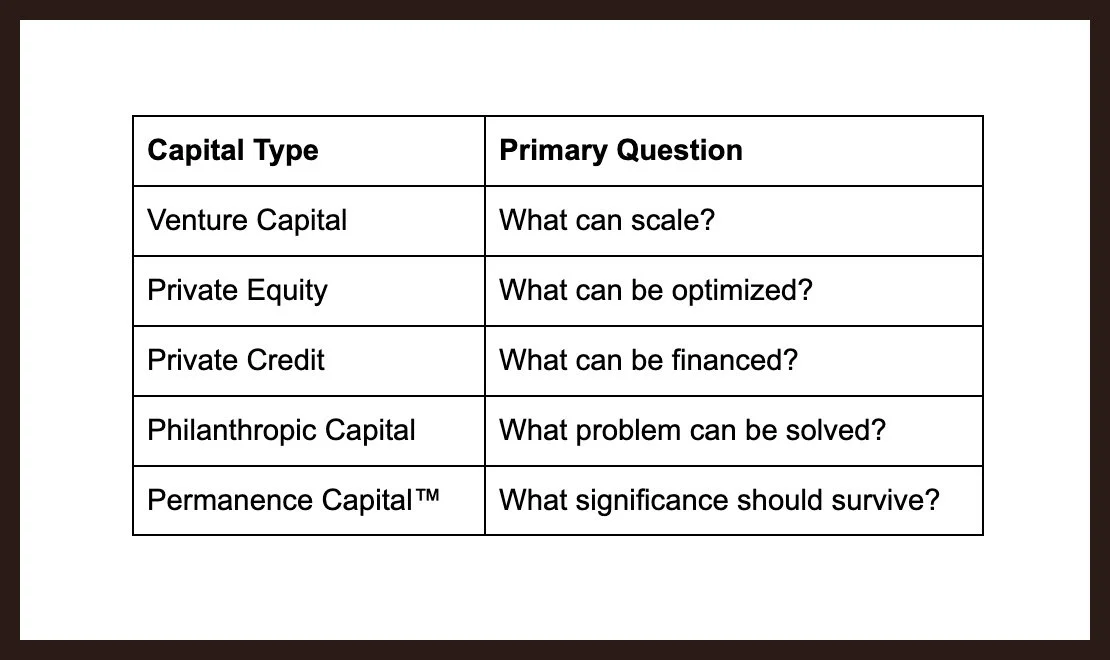
None of these approaches are inherently superior. They simply pursue different outcomes. Confusion emerges when the mandates become conflated. An atelier is evaluated using venture metrics. A museum is evaluated using market metrics. A cultural ecosystem is evaluated using philanthropic metrics.
Each framework captures part of the picture. None fully capture continuity. Permanence Capital™ attempts to address that gap.
The Future Role of the Patron
Under this framework, the future patron is neither donor nor investor alone.
They become something closer to a steward of civilizational capability. Their responsibilities include recognizing significance before consensus forms, financing continuity, supporting transmission, strengthening stewardship infrastructure, preserving capabilities across generations.
This is less about generosity. And more about governance. Not governance in the bureaucratic sense. Governance in the sense of assuming responsibility for the conditions required for significance to survive.
Closing
The future of patronage may not belong entirely within philanthropy. Nor entirely within investing. It may require its own capital logic. One capable of answering a question that neither system was originally designed to solve: What capabilities must remain alive if significance is to survive?
Because every civilization eventually confronts this question. The challenge is not recognizing what matters. The challenge is building capital structures capable of ensuring it endures. And perhaps that is the work Permanence Capital™ was always intended to describe. Not simply funding culture. But preserving the capabilities that allow civilizations to remain recognizable to themselves across time.
This essay sits within a broader body of work examining how significance becomes recognizable, how continuity is stewarded, and how cultural capital endures across generations.
Related inquiries include:
Cultural Capital Is the First Asset Class, exploring why cultural legitimacy frequently forms before economic permanence;
The Preservation of Aliveness, examining aliveness as a precondition for enduring civilizations;
and Underwriting Eternity: Patronage as Sovereign Infrastructure, exploring how patrons, institutions, and stewardship systems help significance survive uncertainty.
Across these works, a central question remains: What deserves continuity, and what structures are required for it to endure?
ABOUT THE AUTHOR
Danetha Doe is an economist, founder, and Architect of Permanence whose work focuses on how significance survives across generations.
Through original frameworks including Permanence Capital™, Legacy Investing™, and Recognition Infrastructure™, she explores the relationship between capital, stewardship, governance, and meaning—helping patrons, family offices, founders, collectors, and institutions steward cultural capital with the same intentionality that traditional institutions apply to financial capital.
ABOUT THE SCHOLAR HOUSE
The Scholar House is the canonical publishing domain of Power Glam™.
It is devoted to the study of permanence, cultural capital, patronage, stewardship, and the systems that allow significance to endure across generations.